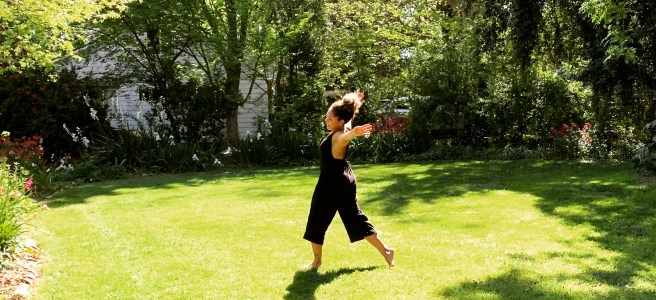
*This piece was written for the Modern Mystic Chronicles podcast, and was read by my friend and podcast creator, Imani Quinn. Listen to the episode here.
My great grandmother was a dancer. When she and my great grandfather moved from Ireland to the states, she danced to his fiddle at bars to supplement their meager income as recent immigrants. I learned about her when my father, originally an anonymous sperm donor, told me when we met — I was 30. When I asked if he had a picture, he said something along the lines of, “Regrettably, I never saw a picture, but family lore is that when she danced she lit up the room. The light of the town.”
I wasn’t supposed to know about my great grandmother Marie or my fiddle-playing great grandfather or their grandchild who would go on to create me. The donation industry and related laws (or lack thereof) don’t acknowledge rights for me as a daughter of their lineage. Yet here I am, a dance-loving woman who can coax shy onlookers to the dance floor. At one of my high school dance performances, my stoic 11th grade history teacher called my dancing “magnetic.” When I learned about Marie I knew immediately what my teacher saw is a part of Marie in me.
I also love the outdoors, but I didn’t know that when I was a kid — my family lives an indoor lifestyle. Apart from feeling vaguely different, and being constantly lured by the small “forest” near the creek in my suburban neighborhood, I had no clue that being outside was a key to my physical, psychological, and spiritual health. I was 26 when I moved to Northern California, and that’s when I found out. The places I felt most myself, most free, most joyful and peaceful, were among the Northern California trees, or beside cold rivers flowing through their forests.
The pieces didn’t make sense then — that there was some spiritual component to the groundedness and belonging l felt upon landing in this region, but it would be revealed to me.
It wasn’t until that meeting with my biological father, where I learned that he too left his home state and triangulated the U.S. until landing and digging into Northern California, that a clearer view of my connection to this land came into focus. His sanity, he told me, is connected to the ability to hike with the trees and take regular trips to the mountains.
Neither of us grew up near mountains, but both of us found them before we turned 30. Whatever desire for hills and green landscapes our ancestors carried manifested in us both, so that we ended up living less than an hour and a half apart — strangers, linked by blood.
The cryobank and laws say we have no enforceable connection. According to those systems, he is not my father, and I have no claim to where I come from. And yet when we met, it was clear that our ancestors called me. Like the plot of the movie Coco, they found me, guided me, and let me see the lineage I belong to. No industry or so-called country has the authority to stop it.
When I was young I felt like I belonged to no one. Sometimes I still feel that way, even now. Growing up in America can do a number on you in terms of what you believe the impact of race to be on your soul. It’s interesting, isn’t it? The idea that race, a human construct based on skin color, can influence your soul — the characteristic of ourselves that is completely separate from, yet connected to, everyone and everything in the universe. Of course, race has nothing to do with the infinite nature of who we really are, but when you grow up in a race-based culture, it can take a lot of unlearning to find out who you are separate from the labels. Same for gender, class, or even political affiliation.
Race is the hardest for my spirit to shake. I grew up with my Black southern family learning about and connected to my Black southern ancestors. Even though I felt their presence in resonant musical chords or in moments when their powerful energy flowed through my body, I felt disconnected because of the difference in my skin. That’s the pesky thing about the construct of race — it constantly has you looking for a box to fit in.
Having lighter skin than the rest of my family was confusing, especially since I wasn’t told that my father was a white sperm donor until I was 16. Unintentional gaslighting of that sort does a number on knowing and intuition, so in that way I was fighting doubt for most of my adolescence, but my spirit knew the truth.
At first I felt guilt with the confirmation that I am half “white.” My excitement to know more about the other half of myself felt like a betrayal of my Black family and ancestors. I still carry some of the guilt, I guess it’s a form of white guilt — that my body may be allowed into spaces where darker bodies aren’t, or that I have somehow benefited from the whiteness that’s a part of me through strictly transactional means.
Fortunately, the majority of the guilt dissipated when I learned about Marie. When I learned about her son, my grandfather, the steady warrior for justice in his white working-class midwestern town. A man willing to fight racist neighbors to stand up for desegregation, who taught his kids, my father, to do the same. More guilt faded with the relief that my father’s lineage does not carry the heaviness of slave ownership — that I only have to contend with that from my maternal line where one or more of my enslaved female ancestors was forced upon by someone white.
My version of white guilt turned into something like pride. My people were the dancers, the anti-racists before it was cool, poor immigrants who risked making a life in a new country. And I felt them dance — both of my lineages together as if they’d conspired in my favor this whole time, dancing in celebration because now I’m in on it too.
I belong to no one but myself. I come from strong lines and hard truths but at the end of the day, my spirit is new, it is my own, and it’s my responsibility to cultivate. It’s why I felt justified to seek out a man who created me anonymously. It’s why I say unequivocally that the California Cryobank and American legal system are wrong to posit that I have no right to the paternal part of my lineage and that it’s fine to continue separating people from their ancestors for profit. It’s how I give myself permission to listen to the ancestors who pull me toward them. It’s how I know that since the beginning, great-grandma Marie danced with me.
 Courtney McKinney